
Wiring and testing electrical equipment and circuits
Expert-defined terms from the Level 2 Certificate in Performing Engineering Operations course at London School of Planning and Management. Free to read, free to share, paired with a professional course.
Wiring and Testing Electrical Equipment and Circuits #
Wiring and Testing Electrical Equipment and Circuits
Wiring and testing electrical equipment and circuits is a fundamental skill in t… #
It involves the process of connecting electrical components together to create a functional circuit and ensuring that the circuit operates correctly through testing. This glossary will cover a range of terms related to wiring and testing electrical equipment and circuits that are essential for the Level 2 Certificate in Performing Engineering Operations.
1 #
Alternating Current (AC)
- **Explanation:** Alternating current is an electric current that periodically… #
In an AC circuit, the flow of electric charge changes direction periodically, typically 50 or 60 times per second. AC is commonly used in household electrical outlets and is generated by power stations.
2 #
Circuit
- **Explanation:** A circuit is a closed loop through which an electric current… #
It consists of electrical components such as resistors, capacitors, and inductors connected by conductive wires. The components in a circuit work together to perform a specific function, such as lighting a bulb or powering a motor.
3 #
Conductor
- **Explanation:** A conductor is a material that allows electric current to flo… #
Common conductors include metals like copper, aluminum, and silver. Conductors are essential for wiring circuits as they provide the path for electricity to travel from one point to another.
4 #
Continuity Test
- **Explanation:** A continuity test is a method used to check if an electrical… #
It involves using a multimeter to measure the resistance between two points in a circuit. If the resistance is low (close to zero), it indicates continuity, while a high resistance indicates an open circuit.
5 #
Current
- **Explanation:** Current is the flow of electric charge through a conductor #
It is measured in amperes (A) and represents the rate at which charge flows past a specific point in a circuit. Current is essential for powering electrical devices and is influenced by the voltage and resistance in a circuit.
6 #
Electrical Safety
- **Explanation:** Electrical safety involves practices and precautions to preve… #
It includes measures such as using insulated tools, wearing appropriate PPE, and following safety procedures to minimize the risk of accidents.
7 #
Insulator
- **Explanation:** An insulator is a material that inhibits the flow of electric… #
Insulators have high resistance to electricity and are used to separate conductors in a circuit to prevent short circuits. Common insulating materials include rubber, plastic, and glass.
8 #
Multimeter
- **Explanation:** A multimeter is a versatile electronic instrument used to mea… #
It typically has multiple functions, including continuity testing, diode testing, and capacitance measurement. Multimeters are essential for troubleshooting and testing circuits.
9 #
Ohm's Law
- **Explanation:** Ohm's Law is a fundamental principle in electrical engineerin… #
It states that the current flowing through a conductor is directly proportional to the voltage across it and inversely proportional to the resistance. The equation for Ohm's Law is I = V/R, where I is the current, V is the voltage, and R is the resistance.
10 #
Parallel Circuit
- **Explanation:** A parallel circuit is a circuit configuration in which compon… #
In a parallel circuit, the voltage across each branch is the same, while the current divides among the branches based on their resistance. Parallel circuits are commonly used in household wiring to power multiple devices simultaneously.
11 #
Resistance
- **Explanation:** Resistance is the opposition of a material to the flow of ele… #
It is measured in ohms (Ω) and depends on the material, length, and cross-sectional area of the conductor. Resistance dissipates electrical energy in the form of heat and is essential for controlling the current in a circuit.
12 #
Series Circuit
- **Explanation:** A series circuit is a circuit configuration in which componen… #
In a series circuit, the same current flows through each component, and the total voltage is divided among the components based on their resistance. Series circuits are used in applications where components must share the same current.
13 #
Short Circuit
- **Explanation:** A short circuit occurs when a low-resistance path is created… #
Short circuits can cause excessive current flow, overheating, and electrical fires. They are typically caused by faulty wiring, damaged insulation, or equipment failure.
14 #
Voltage
- **Explanation:** Voltage is the electrical potential difference between two po… #
It is measured in volts (V) and represents the force that drives electric current through a conductor. Voltage is essential for powering electrical devices and is determined by the energy source or power supply in a circuit.
15 #
Wiring Diagram
- **Explanation:** A wiring diagram is a visual representation of an electrical… #
It uses standardized symbols to represent components such as resistors, capacitors, and switches. Wiring diagrams are essential for understanding circuit layouts, troubleshooting, and designing new circuits.
16 #
Earth Ground
- **Explanation:** Earth ground is a connection to the earth used to protect ele… #
It provides a safe path for excess current to flow to the earth, preventing damage to sensitive components and reducing the risk of electric shock. Earth grounding is essential for electrical safety.
17 #
Diode
- **Explanation:** A diode is a semiconductor device that allows current to flow… #
It has two terminals, an anode (positive) and a cathode (negative), separated by a PN junction. Diodes are used in rectifiers, voltage regulators, and signal processing circuits to control the direction of current flow.
18 #
Capacitor
- **Explanation:** A capacitor is an electrical component that stores energy in… #
It consists of two conductive plates separated by a dielectric material. Capacitors are used in filter circuits, timing circuits, and energy storage applications. They can store and release electrical energy quickly, making them useful for smoothing voltage fluctuations.
19 #
Inductor
- **Explanation:** An inductor is a passive electrical component that stores ene… #
It consists of a coil of wire wound around a core material. Inductors are used in filters, oscillators, and energy storage circuits. They resist changes in current flow and can store energy in the form of a magnetic field.
20 #
Relay
- **Explanation:** A relay is an electrical switch that is operated by an electr… #
It uses a small control signal to open or close a larger circuit, allowing it to control high-power devices with low-power control signals. Relays are used in automation, control systems, and safety circuits to isolate and protect sensitive components.
21 #
Transformer
- **Explanation:** A transformer is an electrical device that transfers electric… #
It consists of two coils, a primary and a secondary, connected by a magnetic core. Transformers are used to step up or step down voltage levels, isolate circuits, and transfer power efficiently.
22 #
Resistor
- **Explanation:** A resistor is a passive electrical component that resists the… #
It is used to control the current in a circuit, limit voltage levels, and dissipate heat. Resistors are characterized by their resistance value in ohms and their power rating in watts. They are essential for designing circuits with specific voltage and current requirements.
23 #
Electromagnetic Interference (EMI)
- **Explanation:** Electromagnetic interference is the disruption of electronic… #
EMI can cause malfunctions, data corruption, and signal degradation in sensitive equipment. Shielding, filtering, and grounding techniques are used to mitigate EMI and ensure reliable operation of electronic systems.
24 #
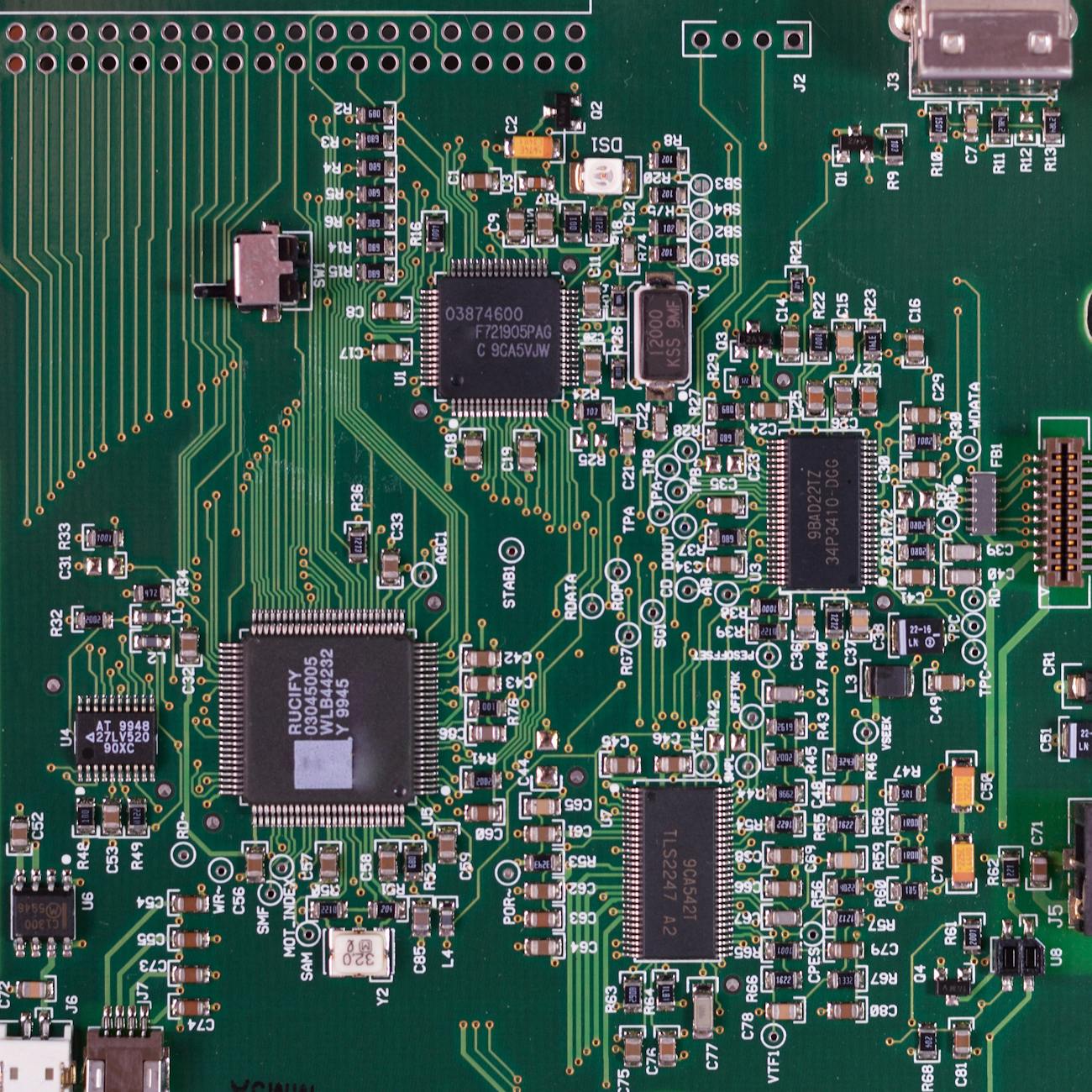
Printed Circuit Board (PCB)
- **Explanation:** A printed circuit board is a flat board made of insulating ma… #
PCBs provide a platform for mounting and interconnecting components in electronic devices. They are essential for miniaturizing circuits, reducing wiring complexity, and improving reliability in electronic systems.
25 #
Oscilloscope
- **Explanation:** An oscilloscope is a test instrument used to visualize and an… #
It displays voltage variations over time on a graphical screen, allowing users to measure signal amplitude, frequency, and timing. Oscilloscopes are essential for troubleshooting circuits, testing signal integrity, and observing transient events.
26 #
Soldering
- **Explanation:** Soldering is the process of joining two or more metal compone… #
It involves heating the solder to its melting point and applying it to the joint, where it solidifies to form a strong electrical and mechanical connection. Soldering is used in electronic assembly, wiring, and repair to create reliable connections between components.
27 #
Fault Finding
- **Explanation:** Fault finding is the process of identifying and correcting fa… #
It involves systematic testing, observation, and analysis to determine the root cause of a malfunction and implement the necessary repairs. Fault finding is essential for maintaining the functionality and safety of electrical systems.
28 #
Safety Procedures
- **Explanation:** Safety procedures are guidelines and protocols designed to pr… #
They include practices such as wearing appropriate PPE, following lockout/tagout procedures, and implementing emergency stop controls. Safety procedures are essential for preventing accidents, injuries, and damage in industrial environments.
29 #
Wiring Regulations
- **Explanation:** Wiring regulations are standards and guidelines that govern t… #
They ensure that electrical installations are safe, reliable, and compliant with national codes and regulations. Wiring regulations cover aspects such as wiring methods, circuit protection, and earthing requirements to prevent electrical hazards.
30 #
Electric Motor
- **Explanation:** An electric motor is a device that converts electrical energy… #
It consists of a stator (stationary part) and a rotor (rotating part) that produce a rotating motion when current flows through the windings. Electric motors are used in various applications, including fans, pumps, and conveyor systems.
31 #
Electrical Test Equipment
- **Explanation:** Electrical test equipment is used to measure, test, and diagn… #
It includes instruments such as multimeters, insulation testers, oscilloscopes, and clamp meters. Electrical test equipment is essential for verifying circuit continuity, insulation resistance, and safety compliance in electrical installations.
32 #
Circuit Breaker
- **Explanation:** A circuit breaker is a protective device that automatically i… #
It acts as a safety mechanism to prevent damage to equipment, fires, and electric shocks. Circuit breakers are available in various types, including miniature circuit breakers (MCBs) and residual current devices (RCDs).
33 #
Wiring Regulations
- **Explanation:** Wiring regulations are standards and guidelines that govern t… #
They ensure that electrical installations are safe, reliable, and compliant with national codes and regulations. Wiring regulations cover aspects such as wiring methods, circuit protection, and earthing requirements to prevent electrical hazards.
34 #
Earth Fault Loop Impedance
- **Explanation:** Earth fault loop impedance is the total impedance of an elect… #
It represents the maximum fault current that can flow in the event of a short circuit or fault. Earth fault loop impedance testing is essential for ensuring that protective devices, such as circuit breakers, can operate correctly in the event of a fault.
35 #
Protective Device
- **Explanation:** A protective device is a safety component that limits or inte… #
Protective devices include fuses, circuit breakers, and residual current devices (RCDs) that detect faults, overloads, and short circuits and disconnect the circuit to prevent further damage.
36 #
Insulation Resistance Test
- **Explanation:** An insulation resistance test is a measurement of the electri… #
It is used to assess the integrity of insulation and detect potential faults or breakdowns. Insulation resistance tests are performed using a megger or insulation tester to ensure the safety and reliability of electrical installations.
37 #
Live Parts
- **Explanation:** Live parts are components or conductors in an electrical syst… #
They are typically energized and can cause injury or death if touched. Live parts must be adequately insulated, guarded, or isolated to prevent accidental contact and ensure the safety of personnel working on electrical equipment and circuits.
38 #
Lockout/Tagout
- **Explanation:** Lockout/tagout is a safety procedure used to prevent the acci… #
It involves isolating energy sources, such as electrical circuits, and securing them with locks and tags to prevent unauthorized operation. Lockout/tagout procedures are essential for protecting workers from electrical hazards and ensuring a safe working environment.
39 #
Phase Sequence Test
- **Explanation:** A phase sequence test is a measurement of the sequence in whi… #
It ensures that the phases are correctly aligned and rotating in the intended direction to prevent motor damage or malfunction. Phase sequence tests are performed using a sequence indicator or phase rotation meter to verify the correct wiring of three-phase equipment.
40 #
Thermocouple
- **Explanation:** A thermocouple is a temperature sensor that generates a volta… #
It relies on the thermoelectric effect to produce a voltage when the temperature at the hot junction differs from the cold junction. Thermocouples are used in temperature measurement, control systems, and thermal management applications.
41 #
Voltage Drop
- **Explanation:** Voltage drop is the reduction in voltage that occurs when cur… #
It is caused by the internal resistance of the component and leads to a decrease in voltage across the load. Voltage drop affects the performance of electrical circuits, particularly in long wire runs, and must be considered when designing and testing circuits.
42 #
Earth Leakage Test
- **Explanation:** An earth leakage test is a measurement of the current flowing… #
It is used to detect leakage currents that could pose a risk of electric shock or equipment damage. Earth leakage tests are performed using a residual current device (RCD) or earth leakage circuit breaker to ensure the safety of electrical installations.
43 #
Megger Test
- **Explanation:** A megger test is a high-voltage insulation resistance test us… #
It applies a high voltage between the conductor and ground to measure the resistance of the insulation. Megger tests are essential for detecting insulation faults, moisture ingress, and breakdowns in electrical systems to prevent failures and ensure safety.
44 #
Wiring Color Code
- **Explanation:** A wiring color code is a system of colors used to identify co… #
It standardizes the identification of live, neutral, and ground wires to ensure consistent wiring practices and enhance safety. Wiring color codes vary by region and are typically specified in national electrical codes to facilitate installation